General ham radio
THE SILENCE BETWEEN THE STARS South Africa's MeerKAT Radio Telescope and the World's Biggest Radio Silence
What is MeerKAT?
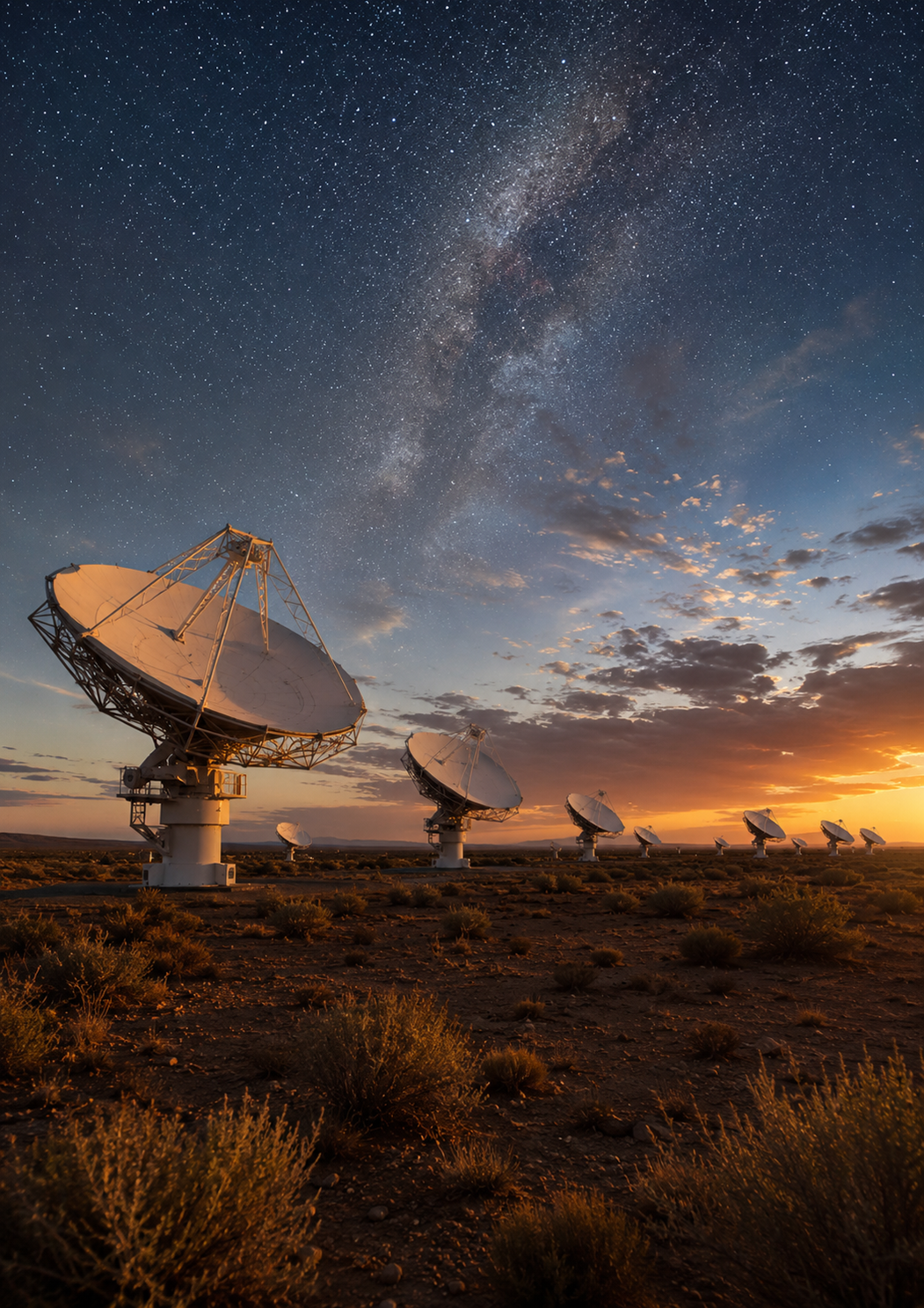
MeerKAT is a radio telescope array operated by the South
African Radio Astronomy Observatory (SARAO), a national
facility of the National Research Foundation. It consists of 64
individual dish antennas, each 13.5 metres in diameter,
spread across an area of roughly 8 km in the Karoo
semi-desert of the Northern Cape. Inaugurated on 13 July
2018 by then Deputy President David Mabuza, it is currently
the most sensitive radio telescope array of its kind in the
southern hemisphere.
The name itself has a pleasing history. The original design
was called KAT — the Karoo Array Telescope. When the
South African government significantly increased the funding
and doubled the number of planned dishes from 20 to 64, the
project was renamed MeerKAT: literally more of KAT. In
Afrikaans, meer means more. It is, in every sense, a very
South African telescope.
Each dish is a marvel of precision engineering. The reflector
surface must maintain its shape to within a fraction of a
millimetre across its full width regardless of temperature,
wind loading, or the angle at which it is pointed. The
receivers mounted at the focus of each dish are cooled to
within a few degrees of absolute zero — colder than deep
space itself — to minimise thermal noise and achieve the
extraordinary sensitivity the instrument requires.
The 64 dishes do not operate independently. Their signals
are combined by a powerful correlator — a specialised
supercomputer — that processes the data from all dishes
simultaneously, effectively creating a single virtual telescope
up to 8 km in diameter. This technique, known as aperture
synthesis interferometry, is the same principle that makes
arrays like the Very Large Array in New Mexico so powerful
— and it is a principle that every amateur radio operator who
has thought about antenna arrays will find intuitively familiar.
A Child of South Africa
What makes MeerKAT particularly remarkable is that it was
designed and built almost entirely by South African
engineers and scientists. The hardware, the software, the
signal processing systems — the vast majority of it was
conceived, developed and manufactured within South Africa.
For a country that sometimes underestimates its own
scientific and engineering capability, MeerKAT is a powerful
reminder of what is achievable.
The telescope is not a standalone project. It was conceived
from the outset as the South African precursor instrument to
the Square Kilometre Array — the SKA — an international
megaproject that will, when complete, become the largest
and most powerful radio telescope ever constructed.
MeerKAT is both a world-class scientific instrument in its own
right and a proving ground for the technologies and
techniques that the SKA will depend on.
Every radio amateur understands RFI. We have all hunted interference — the switched-mode power supply next door
that puts noise across 40m, the solar inverter that kills a quiet band, the laptop charger that raises the noise floor at
exactly the wrong moment. Now imagine scaling that problem up to the point where you need to hear a signal so faint it
carries less power than a single snowflake landing on your antenna. That is the world MeerKAT lives in — and it is why
South Africa did something no other country had ever done on this scale.
A Guinness World Record in Silence
The Karoo Central Astronomy Advantage Area (KCAAA) is officially the largest radio quiet zone on Earth, a fact
confirmed by Guinness World Records. It covers approximately 106,306 square kilometres — an area roughly three times
the size of the previous record holder, the United States National Radio Quiet Zone around Green Bank, West Virginia,
which covers approximately 33,670 square kilometres. To put it another way: the KCAAA is larger than the entire country
of Portugal, or about the size of South Korea.
The legal framework behind this silence is the Astronomy Geographic Advantage Act (Act 21 of 2007), passed by the
South African parliament on 17 June 2007 — more than a decade before MeerKAT's first dish went live. The regulations
came fully into effect in December 2021, establishing a tiered protection system with different levels of restriction
depending on distance from the telescope core.
How the Zones Work
The protection area is not a single uniform zone. It operates in concentric layers, with the most stringent restrictions
closest to the telescope core — located 90 km north of Carnarvon — and progressively more relaxed conditions toward
the outer boundary.What is Actually Banned?
The primary target of the regulations is the radio frequency spectrum from 100 MHz to 25.5 GHz — which covers virtually
every frequency band of interest to radio astronomers and, not coincidentally, almost every wireless device in modern life.
Within the core zones, the following are either prohibited or tightly controlled:Devices Prohibited or Restricted:
• Mobile phones and smartphones
• WiFi routers and access points (802.11 any band)
• DECT cordless telephones
• Bluetooth devices
• Microwave ovens (leak on 2.4 GHz)
• Solar panel inverters and charge controllers
• Switch-mode power supplies of all kinds
• LED lighting drivers (switching electronics)
• Variable-speed motor drives
• Spark-ignition petrol engines (unshielded)
• Wind turbines within 50 km (require permit)
• Amateur radio transmitters
• CB radio
• All broadcast transmitters (TV, FM, AM)
• Radar and navigation transmitters
• Drone remote control systems
Why Each One Matters:
The common thread connecting every item on that list is
unintentional or intentional radio frequency emission. To a
radio astronomer, it does not matter whether a device is
designed to transmit — only whether it radiates energy in the
protected spectrum.
A microwave oven leaks on 2.45 GHz — right in the middle
of an important hydrogen line. A switching power supply
generates broadband hash from kilohertz to gigahertz. A
solar inverter, converting DC to AC at high switching
frequencies, radiates across much of the spectrum. An LED
driver dims its light by rapidly switching the current — and
that switching generates radio noise.
In the core zone, even the power supply for the telescope
itself must be specially engineered and shielded to prevent
self-interference. The SKA construction team is currently
testing prototype remote solar power stations specifically
designed to meet the electromagnetic emission requirements
of the radio-quiet site.
Farmers within the 50 km radius who wish to use WiFi on
their properties, or operate public mobile radio equipment, or
install smart electricity meters, must apply for a permit from
the Astronomy Management Authority. Those who need a
permit to continue existing operations had to register and
apply once the regulations came into full effect in December
2021.
WHAT MEERKAT HEARS
Discoveries from the radio heart of the cosmos
In 2023, the Royal Astronomical Society presented MeerKAT's team with its Group Achievement Award — one of the
most prestigious honours in British astronomy — for what it called 'spectacular advances in radio astronomy' achieved in
a remarkably short period of operation. It was a fitting recognition for an instrument that has, in just a few years, rewritten
parts of our understanding of the universe.
The Bubbles at the Heart of the Milky Way
MeerKAT's most iconic discovery came in September 2019, with the very first scientific result from its complete 64-dish
array. Pointing toward the centre of our own galaxy, astronomers discovered two enormous balloon-like radio-emitting
structures towering hundreds of light-years above and below the plane of the Milky Way. These radio bubbles, stretching
roughly 1,400 light-years across the galactic centre, had been completely hidden from previous telescopes by the blinding
glare of radio emission from the galactic plane itself.
The structures are believed to be the remnant of a phenomenally energetic eruption that occurred near Sagittarius A* —
the four-million solar mass black hole lurking at the centre of our galaxy — several million years ago. Whether triggered
by a burst of star formation that sent shockwaves through the galactic centre, or by a feeding frenzy as the black hole
devoured vast quantities of gas and dust, the bubbles stand as a monument to an event of almost incomprehensible
violence in our galaxy's past. The result was published in Nature and made headlines worldwide.
60 New Cosmic Structures — and Counting
In work published in early 2026, MeerKAT researchers identified 103 diffuse radio sources in galaxy clusters, 60 of which
had never been detected before by any instrument. These findings illuminate how galaxy clusters — the largest
gravitationally bound structures in the universe — evolve, interact and redistribute energy across cosmic scales. Each
new structure is a clue to the forces shaping the universe's large-scale architecture.
Giants in the Deep
MeerKAT has proved to be an exceptional hunter of giant radio galaxies — enormous structures formed when
supermassive black holes at the cores of galaxies launch jets of plasma that travel millions of light-years into intergalactic
space, lighting up as they go. In January 2025, a team from the University of Cape Town published results revealing new
giant radio galaxies discovered with MeerKAT, with co-author Kathleen Charlton noting that the number of such
discoveries had 'absolutely exploded' in the preceding five years thanks to MeerKAT's sensitivity.
Neutron Stars, Pulsars and Gravitational Waves
MeerKAT has been a powerful tool for pulsar science — the study of rapidly rotating neutron stars that emit beams of
radio waves with clockwork precision. By monitoring arrays of pulsars spread across the galaxy, astronomers can use
them as a detector for gravitational waves — ripples in spacetime caused by the most violent events in the cosmos.
MeerKAT contributed to the detection of radio afterglow from a neutron star merger event, earning the RAS Group
Achievement Award mention as one of the instrument's headline breakthroughs.
Connecting with the World
In January 2025, MeerKAT was successfully integrated for the first time with the European VLBI Network (EVN) — the
world's most sensitive network of radio telescopes using very long baseline interferometry. The combined system
produced the highest-resolution images of a distant black hole jet ever achieved from the southern hemisphere, opening
new possibilities for international collaboration and pointing toward what the SKA era will make routine.
Growing the Array — MeerKAT+
MeerKAT is not standing still. The MeerKAT+ expansion project, jointly funded by SARAO and Germany's Max Planck
Society with support from Italy's Istituto Nazionale di Astrofisica, is adding 14 new dishes to the array. The first dish was
delivered in February 2024 and by late 2025, five additional SKA-Mid dishes had joined the array alongside the 64
MeerKAT dishes, bringing the total to 83 antennas. This expanded array, designated SKA-Mid AA1.0, is already
delivering improved sensitivity and survey speed We Share These Frequencies
If you have ever hunted interference in your own shack, you
already understand MeerKAT's fundamental challenge at a
human scale. We all know the frustration of a noise source
that raises the floor on 40m, or a switching supply that puts
hash across a quiet band. Radio frequency interference —
RFI — is to radio astronomy exactly what light pollution is to
optical astronomy: invisible to those who cause it,
catastrophic to those trying to observe through it.
MeerKAT listens on frequencies we use. The hydrogen line
at 1420.405 MHz — one of the most important frequencies in
radio astronomy, used to map the structure of galaxies
including our own — sits in the middle of the 23 cm amateur
band. The telescope's receivers span from around 580 MHz
to 3.5 GHz depending on the feed installed, covering
portions of spectrum that amateur allocations share or
adjoin.
The Karoo's radio quiet zone is not a comment on amateur
radio in particular — it applies to everything equally. But it is
a vivid demonstration of just how sensitive modern radio
receivers can be, and a reminder that our frequencies carry
far more than our signals. Every switching power supply,
every solar inverter, every LED driver we use radiates into
the same spectrum we spend so much effort trying to use
cleanly.
The Same Ionosphere
There is a deeper connection too. The ionosphere that
MeerKAT must account for when it observes at certain
frequencies — the layer of charged particles that refracts and
absorbs radio waves — is the same ionosphere we rely on
for DX. The physics of propagation that lets your FT8 signal
reach Japan on 10m is the same physics that limits what
MeerKAT can observe and when. Radio astronomy and
amateur radio are, at a fundamental level, two activities built
on the same physical foundation.
Radio astronomy has, in fact, given back to amateur radio in
practical ways. The development of low-noise amplifiers for
radio telescope front ends has influenced receiver design
across the industry. WiFi itself — now ironically banned in
the Karoo quiet zone — owes its development partly to radio
astronomy research conducted in Australia. The
technologies flow in both directions.
Pride in Our Backyard
For South African hams, there is a particular reason to pay
attention to MeerKAT: it is ours. Designed here, built here,
operated here — by South African scientists and engineers
— and now recognised as one of the most productive radio
telescopes in the world. The Royal Astronomical Society
does not hand out Group Achievement Awards to
instruments that are merely good. MeerKAT is genuinely
exceptional.
And the best is still to come. MeerKAT will eventually be
absorbed into SKA-Mid — a 197-dish array centred on the
same Karoo site, incorporating the 64 MeerKAT dishes
alongside new SKA dishes built to even more exacting
specifications. Construction is actively under way. By
January 2026, the first SKA-Mid dishes had achieved 'first
fringes' — the moment when two dishes first worked together
as an interferometer, the equivalent of a first QSO for a new
station. First science data from a 64-dish SKA-Mid array is
expected by early 2027.
The SKA — What Comes Next
The Square Kilometre Array will, when complete, be 50 times
more sensitive than any radio instrument currently in
existence and able to survey the sky more than ten thousand
times faster. It will probe the era of cosmic dawn — the
period shortly after the Big Bang when the first stars ignited
— search for pulsars orbiting the black hole at our galaxy's
centre, look for amino acids and complex organic molecules
in distant star-forming regions, and potentially detect signs of
technological civilisations beyond our solar system.
All of this depends on silence. The silence of a
quarter-million square kilometres of the Northern Cape,
enforced by an Act of Parliament, sustained by the
cooperation of farmers, local communities and authorities
across a vast and sparsely populated landscape. It is a
silence that South Africa chose, deliberately and legislatively,
in order to hear the universe more clearly.
Closing Thought
The next time you are on 40m late at night, spinning the dial
through the mix of signals and noise that populates a busy
band, spare a thought for sixty-four dishes in the red Karoo
dust. They are doing what we do — listening to what the
radio spectrum has to tell us — but at a scale and sensitivity
that makes our most sensitive receivers look almost crude by
comparison. They are listening to the universe. And to do it,
South Africa silenced an area the size of Portugal.
That is something to be proud of.
← Back to Blog
tap the key to like
Likes
0